The 20th of February 1974
Official U.K. Albums Chart results from Sunday the 17th to Saturday the 23rd of February 1974
Cut-off for sales figures was up to the end of Saturday the 16th of February
Results counted from Sunday the 17th,
and published on Wednesday the 20th of February 1974.
David Bowie
Pin Ups

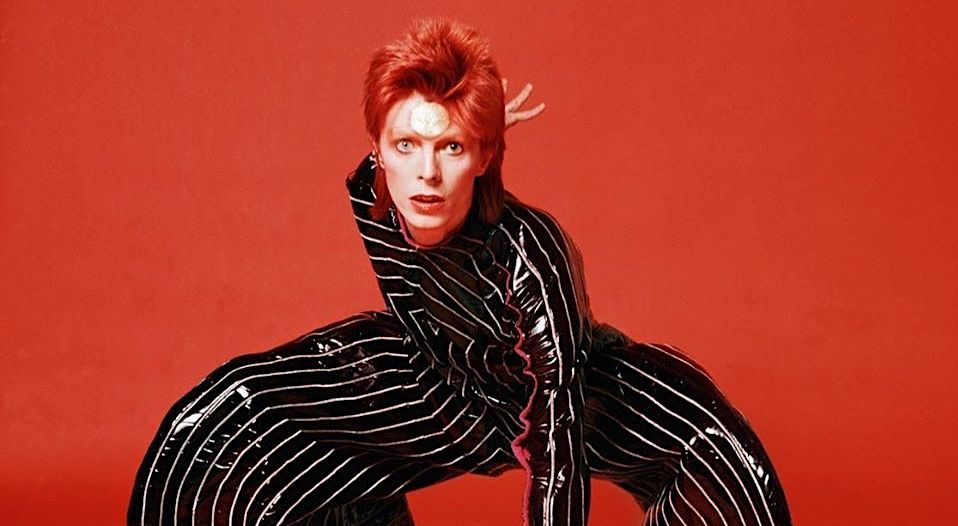
At No.31, on the “The Top 50 U.K. Albums Chart”, the week of my 2nd Birthday, is David Bowie with Pin Ups.
A moment to look back,..
…from a different perspective now.
An album, initially borne out of necessity to allay the ever-greedy demands of the record company executive’s, who were attempting to whip the shit out of their latest and greatest thoroughbred act, and get him to put out another release in time for the Christmas sales last year in 1973. Thanks to his manager, it was decided instead to take some time off of his punishing and relentless schedule and settle into a palatial chateau in France during the summer, where he could relax and record songs reminiscent from his formative years.
So the story goes,..
…just prior to the break, David went through a load of old 45’s and selected the ones which he cherished the most, and which brought back memories of the countless times he visited the Marquee Club to hear these bands play. Songs he’d enjoyed along his own musical road, and which he could now take these singles with him to play during the rehearsal process with the band prior to recording.
For David,
…these songs weren’t just tracks that ran through his journey, these were the songs which had made him into who, and what, he was today. He himself writes on the back sleeve that the songs are from the “64-67 period of London”, at a time when David was himself making inroads into his own determined intention to become a pop star; something he’d apparently told his parents about when he was around the age of 15.
So for this journey, let’s try and get a feel from where David himself was, and the music he was helping to create, when he was first hearing these tracks.
Back then,..
…in 1964, the 17 year-old ‘Davie’ Jones was embarking on that music career with a debut single with ‘The King Bees’, entitled “Liza Jane”.
After only a month,..
…’Davie’ was off, and had hooked up with the Mannish Boys, with his sights (and most probably with his emulated moves too) set on becoming the next Jagger.
This blues outfit, with an 18 year-old David Jones on vocals, released their cover of Bobby Bland‘s “I Pity The Fool“, featuring session guitarist Jimmy Page no less.
Easily distracted,..
…and deciding on another change of direction (is it me, or is there a definite pattern emerging here?), he was off again to now join another new band who, with David, now called themselves ‘Davy Jones & the Lower Third’. This was where The Who‘s influence came to the fore.
With this song “You’ve Got A Habit Of Leaving“, it marked the last time David went by his real name of ‘Jones’. After this point he would go by the surname of ‘Bowie’.
With a new manager,..
…and a new record label, but sticking at this point with the same band, he released another single at the age of 19 called “Can’t Help Thinking About Me”.
After that single,..
…David had moved on once again, and with a new backing band released a couple of singles as David Bowie & The Buzz, one of those being “I Dig Everything“.
By early 1967,..
…and with yet another change of label, the now 20 year-old David Bowie was recording with the Riot Squad and getting heavily influenced by the psychedelic movement overtaking the blues influences of his generation.
Although the group were emulating the sounds of the Velvet Underground, David was now composing his own material in the recording studio. The most highlighted of these tracks being “Little Toy Soldier”.
By now onto his third manager,..
…his next single released would be as a solo artist, but I’m not going to torture you with “The Laughing Gnome“, which had been released recently once again to cash in on his emblazoned success last year in 1973. Instead, to close this chapter of David’s journey, I’ve chosen a track from his debut album which released during the early summer, several weeks after that single.
Those years,..
…had been quite an adventure, and so now David was paying tribute to those times. However, the music press at the time were less enthusiastic with this covers album when it released; with criticisms implying they didn’t do the original recordings justice, or that they didn’t sound the same, or even that most of the tracks were just too different.
In my opinion, the critics just didn’t get what David was up to. If these critics wanted them the same as the originals, then bloody well go back and listen to the originals. The problem was, the critics, especially the British ones, couldn’t separate themselves from when these songs first released back in that era.
To me, these songs were David’s most personal journey yet. They went deep into the heart and soul of David Robert Jones as he was discovering who he was. These songs were with him, and inside of him, when he transitioned to David Bowie. So I’ll suggest my take on how he approached these musical memories.
When listening to this album,..
…and having been back through his own musical highlights of that era, you are witnessing someone emerging into his own made up character that was David Bowie. The songs therefore were put through that Bowie filter. If he’d wanted to attempt to do straight-up no-fuss cover versions of these songs, it would have been at the dangerous risk of exposing his real self; and I really don’t think the album would have sold a fraction that it has if it had been “Jones” “Pin Ups” emblazoned on the cover.
Bowie is a shape-shifting performance artist, not an impersonator.
Although the album’s cover was intended to be for Vogue’s magazine, it fits perfectly here; with David’s and Twiggy‘s faces made to look interchangeable. Twiggy’s presence herself is inspired as it harks back to that very time when her presence in the fashion world was also at it’s zenith; something David would have taken an immense interest in at the time.
So this is David Jones as Bowie, putting his own spin on these tracks. Not emulating them but reinterpreting them entirely. If his last release was nicknamed “Ziggy goes to America”, then maybe this should be “Ziggy goes back in a time machine”. Hence why you have Johann Sebastian Bach‘s Partita No. 3 in E major seguing in from Mike Garson‘s piano playing at the end of Pink Floyd‘s “See Emily Play“. Although I must give credit also to Aynsley Dunbar who does well to emulate Keith Moon’s style on “Anyway, Anyhow, Anywhere” (just to divert for a second – shouldn’t the question mark on the label be for track 6 instead?).
To those who didn’t get the idea behind this album, put the originals that went before out of your mind and instead focus on which character is performing these songs.
As David has most probably thought to himself countless times, some things need to change.
The album…
…had exploded into the chart and shot straight to the top upon entry back in the autumn of 1973, on the 28th of October, where it remained at the top of the tree for the whole of November.
When it does fall back, it doesn’t go far, staying well in the Top 10, all the way through into the new year, and into most of January; but by the time it gets to this month of February, it succumbs to bigger drops, which is where we find it this week.
From here,..
…it will survive several more weeks, before it falls away after the 23rd of March, having picked up 21 weeks for this initial run.
Almost ten years will pass before the album returns to the chart, after yet another of Bowie’s significant transformations, when he enters into the lower reaches of the now expanded Top 100 for the start of a 12 week stay from the 24th of April 1983.
During the rest of that year, the album returns for three week-long stays during July and August.
A re-issued version of the album, with a reshuffled track sequence, and a couple of unreleased tracks added, made a week’s appearance in late July 1990, sitting at No.52.
The final couple of showings take place for the original over twenty five years into the future, when it dips in for a fortnight from the 22nd of January 2016, and then reaches in a little further for it’s last showing so far, getting to No.31 on the 19th of April of that year
So far in total, this LP has now accumulated a grand total of 40 weeks through the years, and I’m sure that one day, that number will grow.


Side 1

Side 2

Many thanks go to the following YouTube channels for providing the chance to hear the tracks so that together we can experience this album release, as it was intended, once again.
Please show your support by visiting their channel.
Grab Your Binoculars, Come Follow Me
My Socials
What is it…?
Who am I…?
When am I…?
Why am I…?
How do I…?

